A qualified protection board is the safety guarantee and lifespan guarantee of a lithium battery. Therefore, a protection board is truly not simple.
Especially for power lithium batteries, because the battery is mobile, various reasons can potentially endanger it, such as collisions, overheating, water immersion, etc.
Recently, there have been many news reports about new energy vehicles catching fire, many of which are caused by external factors. A qualified protection board can eliminate many of these causes.
What are the functions of a qualified lithium battery protection board (BMS)?
Measurement, Management, Evaluation, Communication, Recording
1. Measurement
The first function of a BMS is to collect battery data. That is, to measure various battery data.
Measured data includes voltage, current, temperature, etc.
The most important component of a BMS is the IC, which can be programmed with set data. When the measured data conflicts with the IC's data, the BMS has the ability to take action, such as cutting off power to protect the battery.
As for how to measure voltage, current, and temperature, there are both technical and electronic component issues involved.
If you're interested, I'll introduce this in a new article. Generally, only the CTO of a company needs to learn this level, especially those key technical personnel who design their own BMS. 2. Management BMS manages battery modules from the following three aspects: One is protection. How is it protected? It ensures the battery is in a safe area. One is balancing or redistribution, which can maximize battery capacity. The other is thermal management, similar to protection, which actively keeps the battery in a safe area.
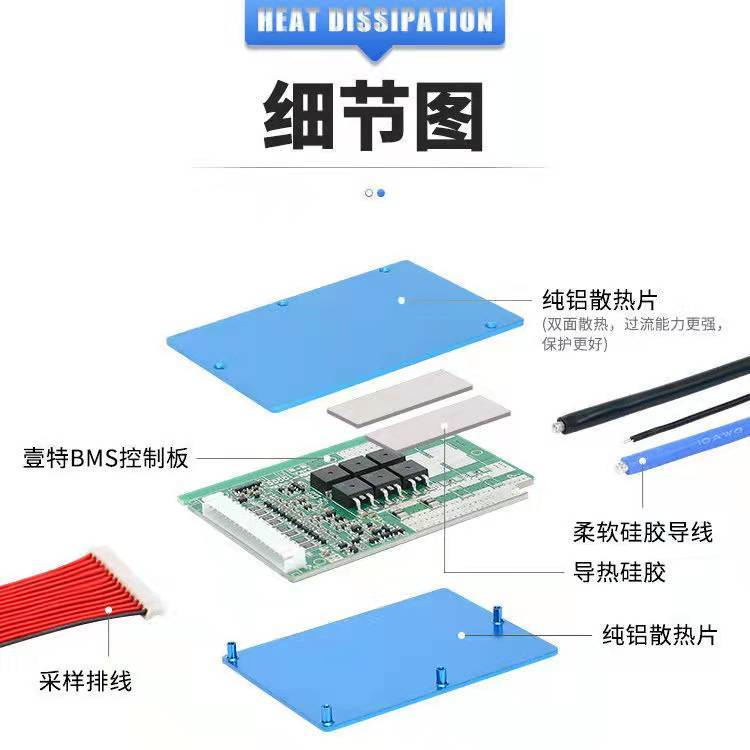
Our protection board contains many MOSFETs. These are the electronic components that perform the protection function. When the detected data conflicts with the IC's data, the MOSFET will cut off the power, thus protecting the battery.
The issue of balancing or redistribution is what we often refer to as passive balancing and active balancing. If you are not familiar with this, you can refer to my previous articles, which explain it very clearly.
Heat treatment involves heating or cooling the BMS, which itself protects the BMS.
3. Evaluation
A qualified BMS should have an evaluation function, which includes:
State of Charge (SOC)
Depth of Discharge (DOD)
Resistance
Capacitance
State of Health (SOH)
This function is only available in digital BMSs; simple analog BMSs do not have these functions.
With these evaluation functions, users can use the BMS more conveniently.
This is the intelligent protection board we often use. It clearly knows when to charge and when to replace the battery cells. GPS can also be added to pinpoint the battery's location. Some businesses, especially those offering shared electric bikes, allow users to set a location range; if the battery is outside this range, the power is cut off. 4. Communication This also falls under the category of intelligent protection boards, such as Bluetooth, RS485, RS232, etc. This greatly facilitates users' understanding of the battery's status. 5. Recorder The recorder can record data from all systems, not just the BMS.
For knowledge about lithium battery protection boards (BMS), you can discuss it with Brother Jiu. Brother Jiu's company specializes in producing lithium battery protection boards; please contact him if you are interested.