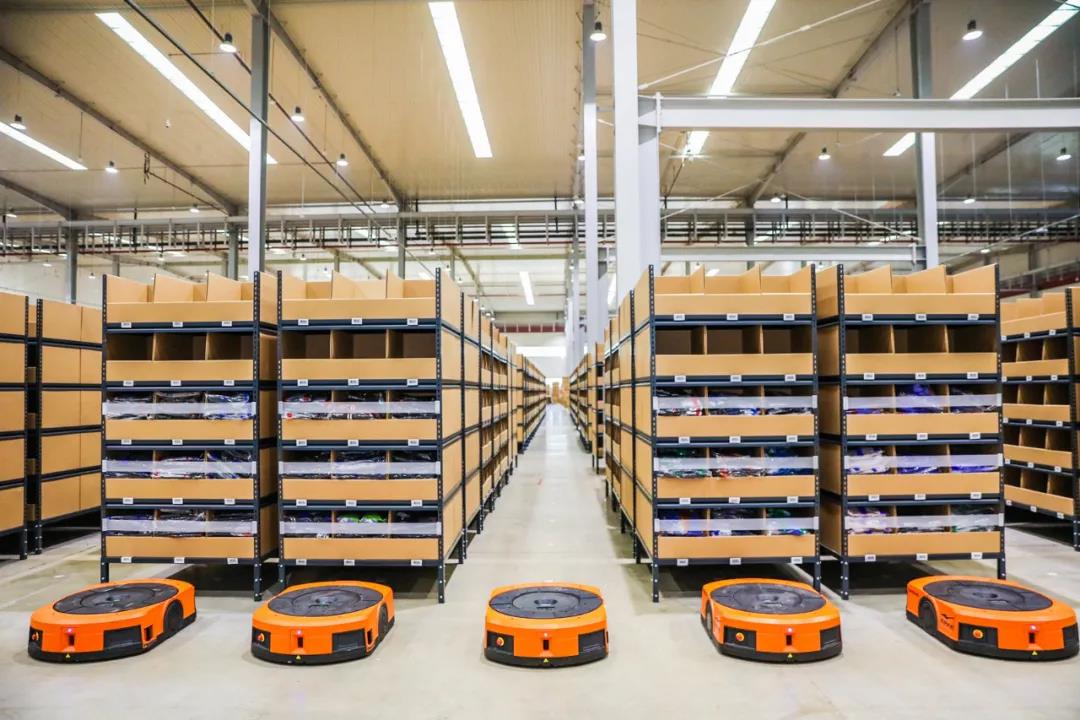
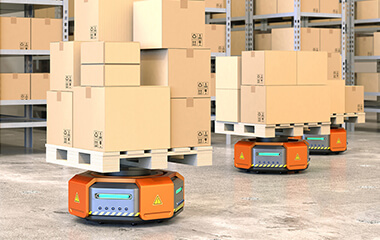
Warehousing is a crucial component of any business, across most industries. In recent years, national requirements for enterprise warehousing have become increasingly stringent. Coupled with the increasing prevalence of intelligent robots in daily life, many companies are adopting unmanned forklifts (AGVs) to replace manual labor. These AGVs require no human driver, offer high positioning accuracy, and effectively reduce labor intensity. They improve production efficiency, efficiently, accurately, and flexibly completing material handling tasks. Today, let's learn about the differences between high-lift AGVs and stacker AGVs with Haima Intelligent, an AGV manufacturer.

Due to similar application scenarios, high-lift forklift AGVs and stacker cranes are in competition, but this competition is limited to a certain height. For example, the maximum lifting height of high-lift forklift AGVs is currently 10 meters, while stacker cranes are above 10 meters. At lifting heights of 10 meters and below, high-lift forklift AGVs have an advantage over stacker cranes due to their flexibility, but above 10 meters, stacker cranes reign supreme.
High-lift AGVs and stacker cranes are complementary, not substitutable. Stacker cranes, used for high-bay racking, can only operate on fixed tracks within fixed areas, while high-lift AGVs can organically combine high-bay racking, warehouse management, and inbound/outbound delivery.
While high-lift AGVs offer unparalleled flexibility compared to stacker cranes, stacker cranes remain more advantageous for high-bay racking (tens of meters or more) and scenarios requiring extremely high inbound/outbound efficiency. In such cases, high-lift AGVs and stacker cranes can be combined; for example, high-lift AGVs handle inbound/outbound delivery, while stacker cranes handle high-bay racking.
High-lift AGVs and stacker cranes fulfill different application needs. Because the operating height of high-lift forklift AGVs is limited by the mast's high-level unloading, and the mast may sway during high-level retrieval operations, their cargo storage and retrieval efficiency cannot reach that of stacker cranes. However, high-lift AGVs are more flexible in application, as they do not require fixed foundation construction like stacker cranes. When building an automated warehouse is not feasible, and when the requirement for high retrieval efficiency is not very high, high-lift AGVs are a suitable choice. Furthermore, the end effector attachments of high-lift forklift AGVs are more flexible and can be adapted to unconventional applications such as double-reach forklifts and multi-forklifts.