Currently, the market demand for residential energy storage mainly falls into two categories. One is in regions with high electricity prices, such as Europe and the United States, where the primary purpose of installing residential solar-energy storage is to achieve economic efficiency in electricity use. The other is in regions with unstable power grids, such as Southeast Asia and Africa, where the primary purpose is to ensure electricity demand. For domestic energy storage companies, the main market for residential energy storage is overseas, making international expansion inevitable. Energy storage is a crucial technology and fundamental equipment supporting new power systems, and different countries and regions have strict certification standards and entry barriers.
Classification of Overseas Certification Systems
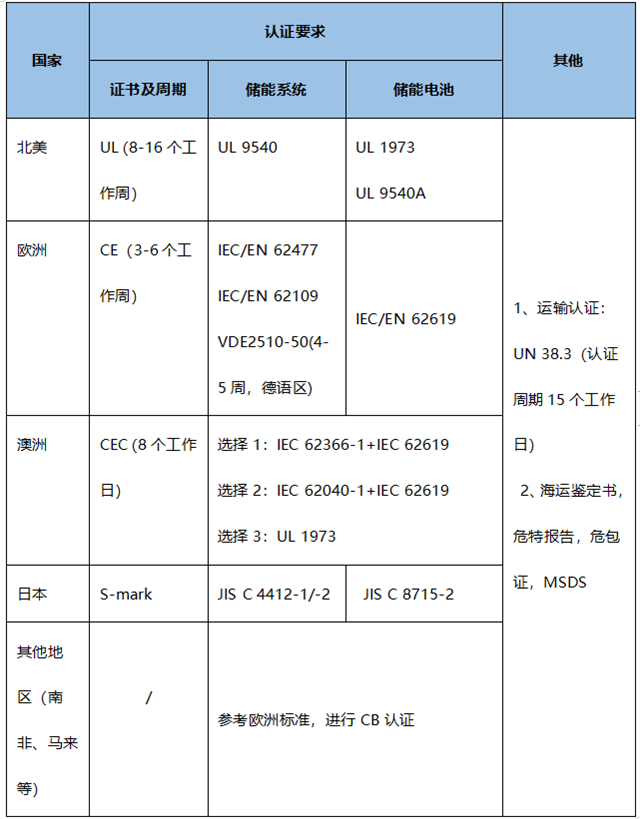
Generally speaking, there are four main types of certification systems: 1. North America: UL certification system; 2. Europe: CE certification system; 3. Australia: CEC certification system; 4. Japan: JIS certification system. In addition, there are transportation-related certifications such as UN38.3, as well as dangerous goods packaging certificates, dangerous goods reports, and maritime inspection certificates.
 Detailed Explanation of North American and EU Certifications
This article focuses on the key testing aspects of North American UL certification and EU CE certification. North American UL Certification: Applicable to North America, primarily for safety testing. The certification cycle is typically around two months. As a joint US-Canada national standard, it enjoys high recognition in the energy storage field. UL 9540: Represents functional safety certification for a fully encapsulated energy storage system, focusing on mechanical, electrical, and environmental testing. UL 9540A: Focuses on fire safety. UL 9540A testing primarily addresses the risk of thermal runaway in energy storage products and improves the system's safety response level by considering four dimensions: battery energy storage system installation parameters, installation ventilation requirements, fire protection facilities, fire protection strategies, and response measures. UL 1973: Certification requires energy storage lithium battery packs to undergo various tests, including combustion tests, overcharge protection tests, over-discharge protection tests, and temperature shock tests, to ensure safe operation of the battery pack under various extreme environments.

EU CE Certification: IEC/EN 62619: Focuses on the safety requirements of energy storage batteries and battery systems. It not only conducts safety tests on cells and battery modules for external short circuits, impacts, drops, thermal abuse, overcharge, and forced discharge, but also evaluates the battery management system (BMS) for overcharge voltage protection, overcharge current protection, overheat protection, and resistance to thermal runaway propagation;
IEC/EN 62477 or IEC/EN 62109: These are general safety standards for energy storage PCS, mainly covering protection against electric shock, energy hazards, fire, heat damage, mechanical and noise hazards, and environmental stresses that may occur during operation, storage, and transportation. VDE 2510: This is a mandatory certification for entry into German-speaking regions, covering most safety risks associated with energy storage systems, including electrical safety, battery safety, electromagnetic compatibility, functional safety, energy management, transportation safety, installation safety, and decommissioning management. In May 2018, the new standard VDE-AR-E 2510-2, requiring low-voltage grid connection for energy storage systems, was released, extending the safety requirements of energy storage systems to the grid end.

Other: 1. Lithium batteries UN38.3: Applicable to almost the entire globe, it pertains to safety and performance testing. Section 38.3 of Part 3 of the UN Manual of Tests and Criteria for the Transport of Dangerous Goods, specifically formulated by the United Nations for the transport of dangerous goods, requires lithium batteries to pass altitude simulation, high and low temperature cycling, vibration testing, impact testing, 55°C external short circuit testing, impact testing, overcharge testing, and forced discharge testing before transport to ensure safe transport. If the lithium batteries are not installed with the equipment, and each package contains more than 24 battery cells or 12 batteries, a 1.2-meter free-fall test is also required. 2. Air/Sea Transport Appraisal Report: For related battery-containing products originating from China (excluding Hong Kong), the final air transport appraisal report must be reviewed and certified by a dangerous goods appraisal institution directly authorized and recognized by the Civil Aviation Administration of China.

.png)
.jpg)