With the increasing popularity of electric vehicles, we are constantly coming into contact with electric vehicle batteries. Currently, lithium batteries and lead-acid batteries are commonly used. But what are the differences between lithium batteries and lead-acid batteries? Which one is more suitable for us? Today, we'll briefly explain the differences between the two types of batteries.
Lead-acid battery: A lead-acid battery (VRLA) is a type of rechargeable battery whose electrodes are mainly made of lead and its oxides, and whose electrolyte is a sulfuric acid solution. In the discharged state, the positive electrode is mainly composed of lead dioxide, and the negative electrode is mainly composed of lead; in the charged state, both the positive and negative electrodes are mainly composed of lead sulfate.
Lithium battery: A lithium battery is a type of battery that uses lithium metal or lithium alloy as the negative electrode material and a non-aqueous electrolyte solution.
Due to the highly reactive chemical properties of lithium metal, its processing, storage, and use require stringent environmental controls. Lithium batteries can be broadly classified into two categories: lithium metal batteries and lithium-ion batteries. Compared to lead-acid batteries, lithium batteries do not contain heavy metal elements (such as Pb in lead-acid batteries), thus avoiding environmental pollution. They also offer flat discharge voltage, no memory effect, low self-discharge, and long cycle life, giving them significant advantages, especially in terms of safety. While lead-acid batteries have a history of use, there are still instances of poor airtightness and easy moisture evaporation leading to thermal runaway. Lithium battery systems, on the other hand, have a built-in battery management system that can monitor and alert in real time, and perform voltage balancing and temperature compensation within the cells. Comparison of lead-acid and lithium batteries: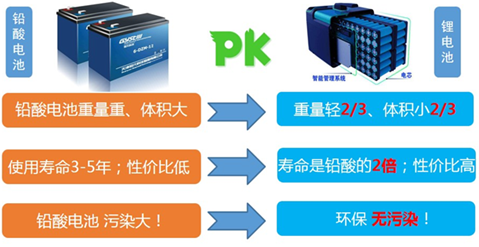
To compare lithium batteries and lead-acid batteries, we need to consider factors such as gravimetric energy density, volumetric energy density, lifespan, price, applicability, national policies, safety, and environmental protection:
1. Gravimetric Energy Density
Currently, the energy density of lithium batteries is generally 200~260Wh/g, while that of lead-acid batteries is generally 50~70Wh/g. Therefore, the gravimetric energy density of lithium batteries is 3~5 times that of lead-acid batteries. This means that for the same capacity, lead-acid batteries are 3~5 times more efficient than lithium batteries. Thus, lithium batteries have an absolute advantage in terms of lightweight energy storage devices.
2. Volumetric Energy Density
The volumetric energy density of lithium batteries is typically about 1.5 times that of lead-acid batteries. Therefore, for the same capacity, lithium batteries are about 30% smaller in volume than lead-acid batteries.
3. Cycle Life
The most popular material systems currently are ternary lithium and lithium iron phosphate (LFP) batteries. Ternary lithium-ion batteries typically have over 1000 cycle lifespans, while LFP batteries have over 2000 cycle lifespans. Lead-acid batteries typically only have around 300-350 cycle lifespans. Therefore, the lifespan of lithium batteries is about 3-6 times that of lead-acid batteries.
|
Project |
Lead-acid battery |
Lithium iron phosphate battery |
|
Lifespan |
The cycle life can reach 2000-3000 cycles, which is longer and results in high cost-effectiveness. |
|
|
Depth of Discharge (DOD) |
40~50% |
80~100% |
|
Size and Weight |
For the same capacity, both are larger in size and weight |
For the same capacity, lithium-ion batteries are 2/3 the size and 1/3 the weight of lead-acid batteries |
|
Charge/Discharge Performance |
No high-current fast charge/discharge performance |
High-current fast charge/discharge (20C) is achievable |
|
Green and environmentally friendly |
Batteries contain large amounts of lead and sulfuric acid. Improper disposal after disposal can pollute the environment. |
Green and environmentally friendly batteries contain no toxic or harmful substances and are pollution-free during production and use. |
|
Self-discharge rate |
<5% |
<2% |
| width="87">
Energy density |
35 Wh/kg |
100~135Wh/kg |
|
Magnification performance |
0.5~1 C |
|
|
Energy Efficiency |
70~75% |
>92@0.5C,>95@1C |
|
Safety |
Lithium battery systems are equipped with their own BMS for convenient online monitoring and to prevent malfunctions. |
|
|
Operating temperature (°C) |
-20~40 |
-20~55 |
.png)