16 Years of Going Global: Chinese AGVs/AMRs Take Center Stage
In 2007, Siasun won General Motors' global AGV tender, becoming a global supplier for GM and pioneering the export of domestically produced AGVs. This project rewrote the history of Chinese robots as "only importing, not exporting," allowing Siasun to enter the user's global procurement system and achieve comprehensive exports to the partner's manufacturing plants in more than 10 countries, including Canada, the United States, South Korea, India, Russia, and South Africa.
Around 2015, the development of warehouse robots spurred a surge in the development of mobile robots in China. From then on, China's mobile robot industry entered a period of rapid development, with emerging startups springing up like mushrooms after rain, and established AGV companies also adapting and revitalizing themselves. By 2017, Chinese companies whose product technologies had been gradually refined and matured domestically began to set their sights on overseas markets. Leading companies such as Geek+, Quicktron, and Guozhi Robotics successively launched projects overseas.
In 2019, overseas sales of Chinese AGVs/AMRs exceeded 1 billion RMB for the first time. In 2020, the pandemic put considerable pressure on companies striving to expand into overseas markets, but it did not stop the pace of domestically produced AGVs going global.
In 2022, overseas sales of Chinese AGV/AMR companies reached 3.6 billion RMB, a year-on-year increase of 44%. According to the New Strategy Mobile Robot Industry Research Institute, the export scale of Chinese AGVs/AMRs is expected to reach around 4.5 billion RMB in 2023, indicating that Chinese companies continue to perform strongly in overseas markets.
2019-2022 China's AGV/AMR Overseas Sales Scale and Growth Rate
From the first export of Siasun's assembled AGV in 2007 to the present, in 16 years, from the breakthrough of one company to the collective overseas expansion of Chinese enterprises, Chinese-made mobile robots have spread all over the world and are widely used in various industries in various countries and regions. The fundamental factor supporting the rapid expansion of Chinese enterprises in overseas markets is that, after nearly ten years of development, China's AGV/AMR industry has basically achieved comprehensive catch-up. Whether in product technology or practical application, Chinese enterprises have taken the lead, and going global is an inevitable path for enterprises to expand into larger markets.
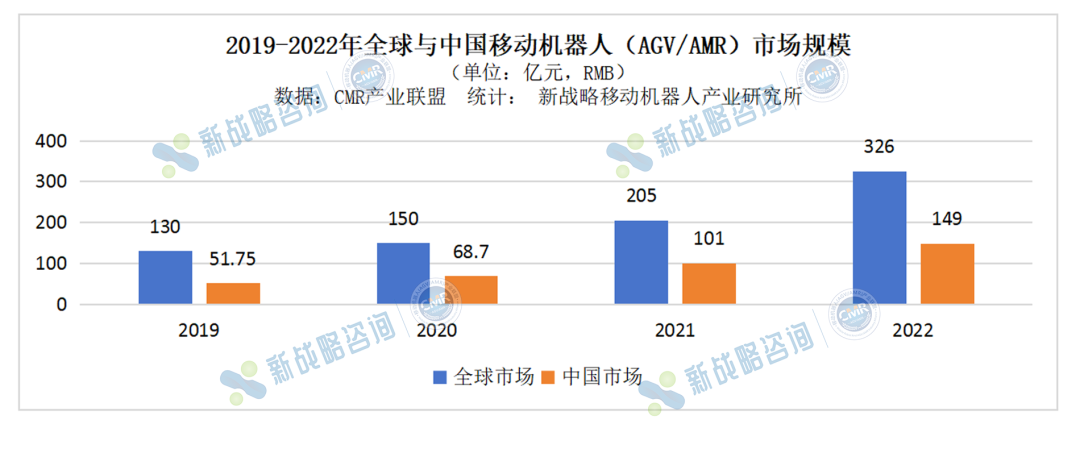
Chart: Global and China Mobile Robot (AGV/AMR) Market Size, 2019-2022
(Note: The Chinese market portion excludes Chinese AGV/AMR sales to overseas markets, which are included in the overseas market size calculation)
Policy Support: The Chinese government has provided strong support for the development of the mobile robot industry. The government has designated intelligent manufacturing and robotics as key strategic emerging industries and has introduced a series of policies and measures to promote their development.
Cost Advantage: Compared with foreign competitors, China has a significant advantage in labor costs, which makes Chinese-made mobile robots highly price-competitive in the global market.
Application Advantage: As a major manufacturing and consumer country, China has abundant application opportunities. Coupled with the experience gained from e-commerce shopping festivals such as Double 11 and 618, Chinese AGV/AMRs have accumulated rich experience in various application scenarios and have successfully addressed various challenges.
Industry Chain Collaborative Development: China's mobile robot industry chain has developed rapidly in recent years, achieving breakthroughs in multiple fields. Upstream and downstream enterprises are engaged in close cooperation, jointly promoting the industry's development. Simultaneously, some companies are actively exploring the integration of mobile robots with technologies such as artificial intelligence and the Internet of Things to achieve more efficient production and smarter material distribution.
In summary, China's mobile robot industry possesses significant competitive advantages and potential in terms of technological innovation, policy, cost, application, and industry chain collaborative development. This forms the foundation for China's AGV/AMR to go global and will support the Chinese AGV/AMR industry in winning the global market.
Leading enterprises drive full coverage from warehousing to manufacturing
In the past two years, among the many companies going global, some leading enterprises have performed exceptionally well, with their overseas market layout becoming increasingly comprehensive and their overseas sales share significantly increasing.
|
Enterprise
|
Related circumstances
|
|
Jizhijia
|
|
Geek+ first ventured overseas in 2017, successfully launching a project in Japan. Subsequently, Geek+ established regional headquarters in the United States, Germany, the United Kingdom, Japan, Singapore, South Korea, and Hong Kong, and built comprehensive local teams. Currently, Geek+ possesses global sales, operations, and service capabilities spanning over 40 countries, empowering over 1,000 major clients worldwide, including Nike, Walmart, Siemens, BMW, Toyota, and DHL.
|
Geek+ pioneered overseas expansion in 2017, successfully launching a project in Japan. Subsequently, Geek+ established regional headquarters in the United States, Germany, the United Kingdom, Japan, Singapore, South Korea, and Hong Kong, and assembled comprehensive local teams. Currently, Geek+ possesses global sales, operations, and service capabilities across more than 40 countries, empowering over 1,000 major clients worldwide, including Nike, Walmart, Siemens, BMW, Toyota, and DHL.
|
|
Siasun
|
In 2007, Siasun began providing AGV equipment to overseas automakers, primarily those in the General Motors group, rewriting the history of Chinese robots as "only importing, not exporting." Currently, its products have been exported to over 40 countries and regions worldwide, providing industrial upgrading services to over 4,000 international companies, and establishing deep cooperative relationships with many Fortune 500 companies.
|
|
Siasun
|
|
|
Jielu Intelligent
|
Focusing primarily on AGV applications in the semiconductor industry, Jielu Intelligent gained recognition from leading domestic semiconductor packaging and testing foundries in 2021. In 2022, with the expansion into international markets, Jielu Intelligent made significant progress in connecting with users in Singapore, Japan, and the United States, securing orders from multiple Singaporean clients. In 2023, it added several new overseas orders, resulting in continued repeat purchases from overseas customers.
|
|
Hy Robotics
|
In 2020, Hy Robotics entered into a strategic partnership with LG CNS of South Korea to jointly develop the South Korean warehouse automation market. Subsequently, it established subsidiaries in Hong Kong, Japan, the United States, Singapore, the Netherlands, the United Kingdom, and South Korea, and collaborated with leading global system integrators to provide warehouse automation solutions and end-to-end services to global customers. To date, Hy Robotics has provided localized services in more than 30 countries and regions worldwide, operating over 1,100 projects.
|
|
Future Robot
|
Since 2020, Future Robot has successively entered the North American, European, Southeast Asian, Japanese, and South Korean markets, and established local service teams. To date, Future Robot has sold more than 2,000 products globally, implemented more than 300 projects, and its business covers more than 15 countries and regions, and has partnered with many Fortune 500 companies. Future Robot's overseas business has grown at an average annual rate of over 300% for three consecutive years.
|
|
Hangcha Intelligent
|
In 2018, Hangcha Intelligent began its overseas business expansion, with its first project in the photovoltaic industry. It subsequently completed several implementation projects, making the United States its main overseas market. That same year, it entered Vietnam, completing its first Southeast Asian project in the apparel industry. It continued to deepen its presence in Vietnam, and in 2020, it completed its first overseas project worth tens of millions of yuan in the traditionally strong tire industry. Starting in 2021, it expanded into the European market, conducting business in Hungary and the Netherlands.
|
|
Haitong Robotics
|
In 2022, HITO began its expansion into overseas markets, focusing on North America and Europe. That same year, it signed a strategic cooperation framework agreement with INDI EV to implement the construction and design of its vehicle assembly plant in Los Angeles, USA, in phases. In 2023, HITO established subsidiaries in Los Angeles and Singapore, setting up overseas production bases and building a professional team integrating design, production, and after-sales service. Simultaneously, sales representative offices and after-sales teams were established in the Netherlands, Zurich, and Germany.
|
|
Yiwu Technology
|
Entering the international market at the end of 2021, its technology has been recognized by customers in various industries in multiple countries. It has successively made its mark in the Japanese, South Korean, South American, European, and Southeast Asian markets, and quickly launched its first overseas multi-vehicle dispatching project in South Korea in the first half of 2022. In 2023, it reached a strategic cooperation agreement with Lotte International Logistics, a subsidiary of the South Korean retail giant Lotte.
|
Chart: Some Representative Chinese AGV/AMR Companies Going Global
Among the major exporting companies, overall, warehouse robot manufacturers are expanding overseas faster than production line AGV manufacturers. Because warehouse robot products are relatively standardized, they are easier to implement and deliver projects overseas. Production line AGVs, due to their higher degree of customization, require more sophisticated local delivery and after-sales teams. However, in the past two years, with the further improvement of domestic companies' overseas market layout, domestically produced AGVs/AMRs are gradually expanding from warehousing and logistics scenarios to various fields of manufacturing overseas, and more and more production line AGV companies are starting to go global, embarking on a new round of expansion.
In the process of expanding overseas, in order to further improve project delivery efficiency, the standardization of hardware and software products is becoming a key development direction for enterprises. The ease of use of the robot body and related systems is, to some extent, a key factor in determining whether an enterprise can succeed in the international market.
From a market layout perspective, the main overseas target markets for Chinese AGV/AMR companies currently include Europe, North America, Japan and South Korea, and Southeast Asia. These regions have a large demand for mobile robots, and the market is growing rapidly.
Domestic AGV/AMR companies are expanding overseas, and their entry models mainly fall into the following three categories:
Chart: Main Overseas Expansion Methods of Chinese AGV/AMR Companies
Overall, facing the vast global market, Chinese AGV/AMR companies have great potential.
However, opportunities and challenges coexist. In the process of going global, Chinese AGV/AMR companies also face issues such as technological innovation and intellectual property rights, market demand and acceptance, competitive pressure, policy environment, and trade barriers. In the future, how to better leverage their strengths and address their weaknesses requires further consideration from these companies.

.jpg)
(1).png)
.jpg)